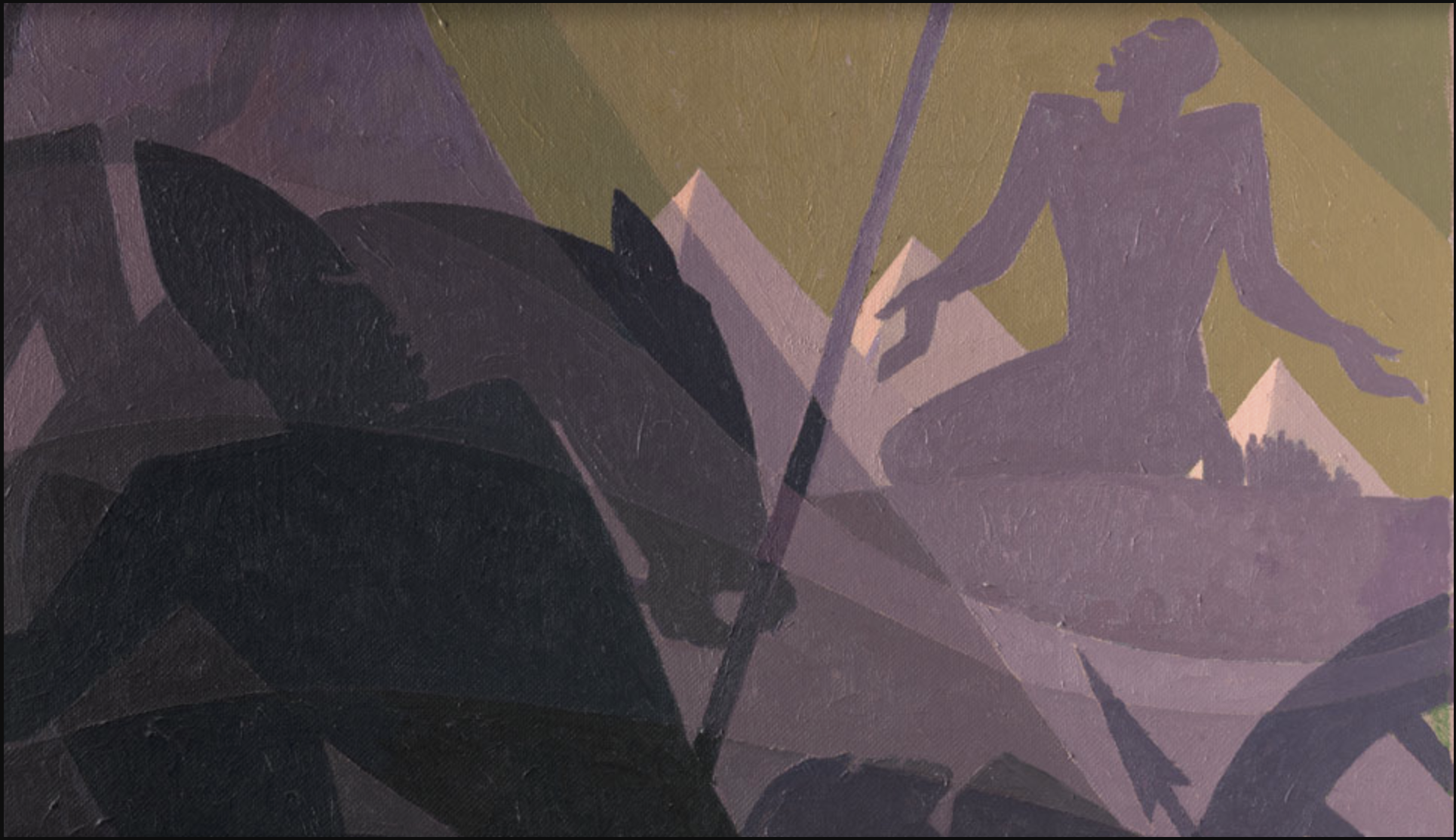
Aaron Douglas, “Let My People Go” (c. 1934-39, oil on masonite)
Exodus is About Communion With God
Most Christians read Exodus as a deliverance story. Israel is in slavery, God hears them, raises up Moses, breaks Pharaoh, parts the sea, gives the law, and brings them to the edge of the promised land. The plot is rescue and the point is freedom. The application, on a thousand Sunday school worksheets and in just as many sermons, is that God delivers His people from bondage.
This reading is not wrong. I’ve preached it. It is, however, two-thirds short.
The deliverance from Egypt is finished by Exodus 15. There are twenty-five chapters after the song at the sea. If the book were primarily about getting Israel out of Egypt, the editor was extraordinarily inefficient, since most of the story is devoted to what happens after the exit. The bulk of Exodus is not about getting the people out of Egypt. It is about getting God in. The book is driving toward something the deliverance was meant to make possible.
Owen on Communion
In John Owen’s Communion With God, his claim was that ordinary Christians have intimate, personal fellowship with each Person of the Trinity, distinctly and together, and that the cultivation of that fellowship is the substance of the Christian life. He defined communion as “his communication of himself unto us, with our returnal unto him of that which he requireth and accepteth, flowing from that union which in Jesus Christ we have with him.”
God communicates Himself. The saint makes a returnal (return). The whole exchange arises from union with Christ. Each Subsistence gives what is proper to Him: the Father, His love; the Son, His grace; the Spirit, His consolation. The saint, by the same Spirit, gives back faith, love, and obedience. The 1689 London Baptist Confession says the same thing in fewer words when it describes the saints as having communion with God in His Son, Jesus Christ, by which they share in His grace, suffer with Him, are conformed to His image, and are made partakers of His Spirit (27.1).
The book of Exodus is not finally about deliverance, or law, or land. It is about a holy God communicating Himself to a covenant people, and a covenant people learning, slowly and badly, to give back what He requires.
Four Critical Words
The book of Exodus begins in silence. Israel has been in Egypt for four hundred years. The brick quotas are crushing, the boys are being drowned in the Nile, and the patriarchal promises are old enough that no one alive has heard them spoken by anyone who received them firsthand. From every external indicator, the God of Abraham has gone quiet, perhaps for good.
Then we read four verbs at the end of chapter 2: God heard. God remembered. God saw. God knew (Exodus 2:24-25).
These words are the first sketches of communion. The God who hears the groan, who remembers the covenant, who sees the affliction, and who knows His people by name, has been communicating Himself to them all along, even through four centuries of silence. He has been attentive. He has been faithful. He has been bound to them by covenant when they had nearly forgotten He existed.
But notice, the text does not say Israel returned anything back to Him. They were groaning, not praying. They were crying out in pain, not addressing Him by name. The communication has been entirely one-sided for four hundred years, and the question from this point forward is whether a stiff-necked people can ever be brought to receive what God is giving and give back what He requires.
The Bush in Midian
The first sustained two-way exchange takes place on a Midianite hillside, between God and Moses, the runaway shepherd. The figure who meets Moses at the burning bush is identified in the text as both “the angel of the LORD” and “the LORD” (Exodus 3:2, 4). Owen, with much of the Reformed tradition, takes this to be the pre-incarnate Son. Calvin says the same. So does Edwards. The figure is no created angel; the speaker takes to Himself the divine Name.
The communion being initiated at the bush is already Trinitarian. The Father, whose love elects Israel, sends the Son to come down to His people. The Son makes the promise that will eventually contain the whole indwelling work of the Spirit: “I will be with you” (Exodus 3:12). What the Son communicates to Moses in this conversation is the substance of communion in compact form. He gives the divine Name, I am who I am, the warrant of every promise that follows. He gives His personal commitment to be present. He gives the Father’s intent, I have come down to deliver them. What He requires of Moses is faith in His Word and obedience to a frightening commission.
The book of Exodus is not finally about deliverance, or law, or land. It is about a holy God communicating Himself to a covenant people, and a covenant people learning, slowly and badly, to give back what He requires. Share on XBut Moses returns the faith badly. He hesitates, argues, manufactures excuses, and tries hard to be dismissed, and through all of it, the Lord does not withdraw. He gives signs. He gives Aaron. He bears with Moses until Moses goes. The pattern that will play out across the remainder of the book is already present: the Lord’s communication of Himself does not depend on the perfection of the faith or obedience of the people. The communication is what makes faith and obedience possible. Communion is not something Moses works up. It is something the Lord initiates, sustains, and invites His people into.
A Meal Under the Blood
The plagues are usually read as judgment, and they are. But the Lord’s own framing is not primarily judicial. That you may know that I am the LORD. That my name may be proclaimed in all the earth. He is making Himself known to Egypt and to Israel both, and even in wrath, He is communicating Himself.
The clearest evidence that the plagues serve communion comes on the night of the tenth, when the Lord could have spared His people invisibly, but instead called on them to participate in a meal. In Exodus 12, He instructs them to take a spotless lamb. Kill it at twilight. Paint the blood on the doorposts and the lintel. Sit down inside the house and eat the lamb together, dressed for travel, while the destroyer moves through Egypt outside.
The first event of Israel’s freedom is a family meal under the cover of blood, eaten in the presence of a God who is passing over them in mercy and feeding them at His own appointment. The whole pattern that will fill the rest of Scripture, including the Lord’s Supper, is laid down in that one evening. The Father’s love elects. The Son’s grace is figured in the spotless Lamb whose blood covers them. The Spirit’s consolation comes in the strange joy of a frightened family eating together while death moves past their door. The “returnal” asked of them is simple and almost unbearable: faith that the blood will hold and obedience to an unusual command.
Hours later, when the sea closes behind them, and the people break into song on the eastern shore (Exodus 15), what we hear is Israel’s first sustained return as a free people. The LORD is my strength and my song, and he has become my salvation. The Lord has communicated salvation, and Israel returns worship.
But it will collapse within days.
The Wilderness is Where Communion Meets the Heart
Within three days, the people are grumbling about the water at Marah because it tastes bad. A few weeks later, they are grumbling for bread. A few weeks after that, water again at Rephidim. The grumbling has a peculiar shape that is always nostalgic. We should have stayed in Egypt. At least there we had meat.
The chains on the wrists are gone, but the chains on the heart are still there, and the wilderness is where it shows. The wilderness years are where the depth of remaining corruption becomes intelligible to a delivered people, often for the first time.
The Lord’s response is sustained self-communication. He provides manna in the morning, every morning, six days a week; He gives them water from the rock when there is no water anywhere; He is present in a pillar of cloud by day and a pillar of fire by night. This is communion in which the people are taught, day by day, that they live by the word and provision of the God who has come down to be with them. The faith Israel is being trained in is not the dramatic display of the song at the sea, but the unglamorous faith of trusting that the manna will be there in the morning because He has said it will. Most of the Christian life takes this form. Not the high moments of conversion or breakthrough, but the daily exchange of a faithful God communicating Himself in small mercies and the Christian learning, slowly, to receive them as gracious provisions from a loving hand. If you want to assess the state of your communion with God, look at how you handle the manna.
Sinai and the Shape of Approach
Three months after the sea, the Lord brings the people to a mountain. At Sinai, the pattern is given covenantal language for the first time at scale. You shall be my treasured possession among all peoples … a kingdom of priests and a holy nation (Exodus 19:5-6). The fuller formulation comes later: I will be your God, and you shall be my people. He communicates Himself as their God. They are required to return covenant fidelity as His people.
But the approach is dangerous. The mountain shakes, the trumpet sounds, and the voice thunders. The Lord tells Moses, “Set limits for the people. Whoever touches the mountain shall be put to death” (Exodus 19:12). Anyone who crosses the line, even an animal, dies. The God who is communicating Himself is also infinitely holy, and communion with such a God cannot be entered on the people’s own terms. It requires mediation, blood, consecration, and a way of approach.
After the people swear all that the LORD has spoken we will do, Moses sprinkles them with covenant blood (Exodus 24:8) and goes up the mountain with seventy of the elders. They go up. They see God: under his feet there was as it were a pavement of sapphire stone, like the very heaven for clearness. Remarkably, “He did not lay his hand on the chief men of the people of Israel; they beheld God, and ate and drank” (Exodus 24:11).
These are men whose grandfathers had been making bricks in Egypt. Six months earlier, none of them had ever been more than a few miles from Goshen. Now they are sitting on a sapphire floor, having a meal in the presence of the Almighty. This is the closest the Old Testament will come to Owen’s communion before Christ.
The Catastrophe
Forty days later, still in their blood-stained clothes, the people made a golden calf. They threw a feast for it and held a parody of the very meal they had just shared with God on the mountain, this time in front of a metal animal that could not communicate with anyone. They broke communion with God. The people who had just been received into covenant fellowship pledged their allegiance to a god who is not God. They gave love and worship to a lifeless statue. Communion is mutual self-giving, and Israel had just severed the human side of the exchange.
But Moses pleads in the breach. The Lord relents from total destruction, yet when the people are spared, the Lord says, “I will send an angel before you. I will give you the land. But I will not go up among you, lest I consume you on the way, for you are a stiff-necked people” (Exodus 33:3). In other words, you will get the land, but you will not get Me.
This is the loss of communion in the strict sense. Every other blessing remains on offer (the land, the angel, the promises kept), but what is being withheld is the very thing Owen says communion is: the personal self-communication of God to His people. The Lord is offering to be a benefactor without being a husband. The gifts without the Giver.
For the first time since the night they walked out of Egypt, the people understood what the whole exodus had been for, so “They mourned, and no one put on his ornaments” (Exodus 33:4). The land was nothing without the Lord. The promises were useless without Him. They would rather stay in the desert with Him than enter Canaan without Him. Moses courageously asked, “If your presence will not go with me, do not bring us up from here. Is it not in your going with us, so that we are distinct, I and your people, from every other people on the face of the earth?” (Exodus 33:15-16). The thing that makes Israel who they are supposed to be is communion with the Lord. Take that away, and they are refugees with an interesting story. Israel mourning at the foot of the mountain is the right response of a people who have finally understood what was on the table. The Lord answers, My presence will go with you, and I will give you rest, and communion is restored by sheer grace.
Show Me Your Glory
Having argued the people back into the presence, Moses presses for one more thing: “Please show me your glory” (Exodus 33:18). This is communion in its purest form. The Father has communicated covenant love. The Son, the angel of the covenant, has been speaking with Moses face to face as a man speaks with his friend. What Moses returns, having tasted that fellowship, is a desire for more. He has had enough of the Lord to know that any distance from Him is unbearable. God communicates Himself, and the child of God, having received, longs for more.
The Lord’s answer is the answer of all true communion in this age. “I will make all my goodness pass before you, and I will proclaim before you my name. But you cannot see my face, for man shall not see me and live” (Exodus 33:19-20). He puts Moses in a cleft of the rock, covers him with His hand while the glory passes by, and lets him see only the afterglow. The proclamation in chapter 34, the LORD, the LORD, a God merciful and gracious, slow to anger, and abounding in steadfast love and faithfulness, is the Father’s self-communication of His character. What passes between Moses and the Lord on that ledge is mutual exchange in its most concentrated Old Testament form. God communicates His goodness. Moses bows his head and worships (Exodus 34:8).
The afterglow alone is enough to make Moses’s face shine so brightly when he comes down that the people cannot bear to look at him. The saint who has had communion with God carries something of God on him afterward, often without knowing it, and the people around him often see it before he does.
The Dwelling
The book of Exodus ends with a structure. Sixteen chapters are spent on the tabernacle, and most modern readers skip them. The lists of cubits, acacia wood, and goat hair seem tedious to people who do not care about furniture. But the tabernacle is the answer that Exodus actually gives to the question it has been asking throughout. How can a holy God communicate Himself to a stiff-necked people without consuming them? The book’s answer is a tent.
The tent is portable because the Lord is going with them. It has graded layers of access: the outer court, the Holy Place, the Most Holy Place, with a bronze altar at the entrance because no one approaches without atonement, a basin for washing because no one approaches unclean, and a veil with cherubim woven into it because the way to the unmediated presence is guarded. In the most interior chamber sits the ark of the covenant, with the mercy seat on top, where the cloud of glory rests. Every detail is communicating something about how a holy God can dwell with sinful people without destroying them. The whole structure exists for one purpose: “Let them make me a sanctuary, that I may dwell in their midst” (Exodus 25:8). The shape of the dwelling is dictated by His holiness. The existence of the dwelling is dictated by His love.
The tabernacle is built for ongoing communion. There were daily sacrifices in the morning and the evening; incense burning continually before the veil; priests with the names of the tribes engraved on their shoulders and worn over their breastpieces, carrying the people into the presence and back out again. The whole apparatus is built so that the Lord’s communication of Himself and the people’s response of love and sacrifice and prayer and obedience can become the daily rhythm of a nation.
The book ends with the cloud descending on the finished tent and the glory of the Lord filling the tabernacle. Communion will hold for as long as Israel holds the covenant from her side, which the rest of the Old Testament will show is not very long at all.
The Mediator the Book Has Been Waiting For
The whole apparatus of Exodus, the tabernacle and its sacrifices, Moses and his intercession, the cleft of the rock and the afterglow on a prophet’s face, was holding the place open for a Mediator who could close the gap that no son of Adam could close. In the fullness of time, on a different mountain, in a garden, a Man kneels and sweats blood. Father, if it is possible, let this cup pass from me. Christ becomes what Moses could not be. He intercedes, and He bears the wrath that justice required. He is the Lamb the Passover figured. He is the bronze altar where atonement is made. He is the basin where the unclean are washed. He is the veil that was torn from top to bottom when His body was broken on the cross, opening the way to the Most Holy Place that had been guarded since Sinai. He is the mercy seat where God meets man. He is the cleft of the rock where every sinner is hidden when the glory passes by.
In Him, communion no longer rests on a fragile institution. It rests on the perfect faithfulness of the Son, who has kept the covenant on our behalf. His righteousness is the basis of our acceptance. His Spirit is the agent of our faith and obedience. The God who told Moses he could not see the face and live has now shown that face in the face of Jesus Christ, and the saint lives by looking at it (John 1:18).
Communion in Owen’s full sense is now possible because the union is now real. The Father loves us. The Son sanctifies us by the Spirit. The Spirit assures us of the Father’s love, intercedes for us, and forms in us the very return that God requires. Each Person communicates what is proper to Him, and the Christian, by the Spirit, is given the capacity to give back what is required. This is the Christian life, and it is what Exodus has been pointing toward for forty chapters.
The Shape of Communion
The Lord’s Supper is the meal of the new covenant, the present-tense form of what Israel tasted at Exodus 24:11. By the Spirit, the risen Christ is genuinely present at His table for those who come by faith, and the saints really feed on Him to the strengthening of their souls (1689 LBCF 30.7). The Supper is communion in compact, concentrated form, and it should not be reduced to bare memorial.
But the communion the book of Exodus has been pressing toward through forty chapters is not, finally, a thirty-minute experience on Sunday morning. It is the saint’s daily life. It is the Word read in private, where the Father communicates His love in the very lines of Scripture. It is weakness brought to the Son, where His grace proves sufficient. It is prayer in groans that the Spirit Himself helps us make. It is Sabbath rest, where the Lord communicates His finished work and Christians return trust. It is the gathering of the saints, where the body of Christ becomes the place where the love of the Father is given. It is suffering held in the presence of a God who has come down. It is obedience, not bare duty, but the believer’s thankful response.
When Israel mourned at Sinai, the benefits without the Giver were the worst thing the Lord could have offered, and they knew it. We must have that same instinct. And if you are in Christ, you too have the blessing of beholding God, eating, and drinking. Not yet face-to-face. Not yet without the cleft of the rock. But really, truly, by the Spirit, in the face of Jesus Christ, the saint has communion with God: with the Father in His love, with the Son in His grace, with the Holy Spirit in His consolation, all of it flowing from the union that is yours forever in Him.
The God who heard, remembered, saw, and knew at the end of Exodus 2 is the same God who, at the end of all things, will say from the throne, “Behold, the dwelling place of God is with man. He will dwell with them, and they will be his people, and God himself will be with them as their God” (Revelation 21:3).



Nick Kennicott is a pastor at Emmanuel Baptist Church in Coconut Creek, Florida. He is the president of Reformed Baptist Seminary and the resident professor of classical studies. He is the founder of the Institute of Pastoral and Theological Training in Egbe, Nigeria. He is a graduate of the Baptist College of Florida and Knox Theological Seminary and is completing his Ph.D. dissertation at Faulkner University. Nick is a co-author of the book In Praise of Old Guys, editor of Keach’s Baptist Catechism in Modern English, and author of Expository Outlines and Observations on Galatians (2027, Mentor/Christian Focus). He is married to Felicia, and they have three children.