
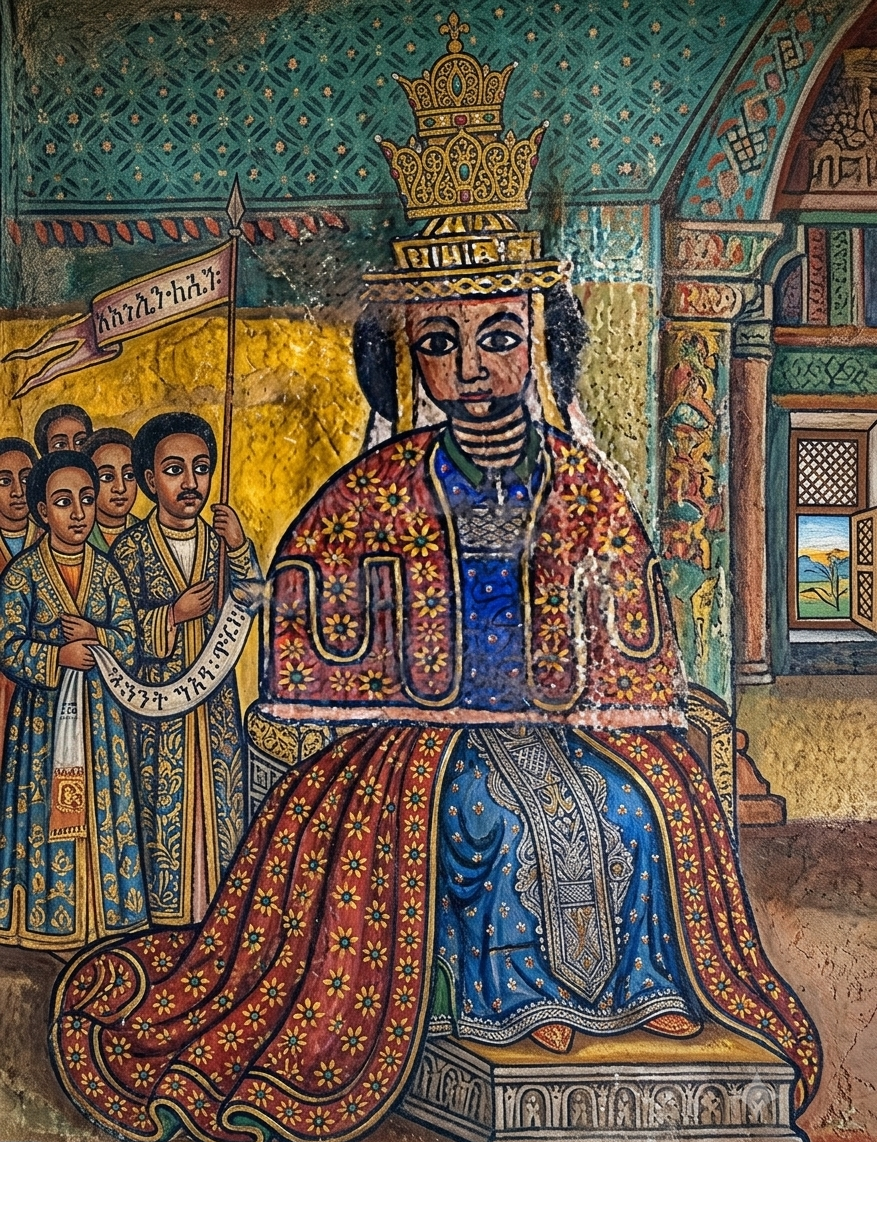
At the southwest corner of the Red Sea, around AD 300, lay a thriving African empire called Aksum, sitting at the one choke point connecting Rome, Arabia, and India. If you wanted to trade with the East, you went through Aksum. That is the empire our story belongs to, and the king at its center is a man history calls Negus Ezana, negus being an old Ge’ez word for “king.”
I love telling this story because it cuts the legs out from under one of the West’s most pervasive lies: that Christianity is a white man’s religion, imported to Africa at the point of a sword. Ezana’s conversion says otherwise. It says the gospel reached Africa the same way it reached everywhere else: through ordinary, faithful people committed to proclaiming the gospel.
Start with Acts 8. Long before Ezana, an Ethiopian eunuch, more accurately a Kushite official serving the Kandake, the queen of Kush (a different kingdom than Aksum, though ancient writers lumped both under the name Ethiopia), reads Isaiah on a chariot and asks Philip to explain it. “How can I, unless someone guides me?” he asks (Acts 8:31, CSB). He believes, he is baptized, and he goes home. That single verse tells you the gospel was already moving into sub-Saharan Africa in the first century, carried by a man whose wealth and position gave him access to a handwritten Isaiah scroll. That was no small thing in an age with no printing press and no Bible app.
Fast-forward two centuries. Two young Syrian Christians, Frumentius and Aedesius, are sailing the Red Sea when Aksumite raiders attack their ship, killing everyone aboard except the two of them. They are dragged into Aksum as captives. But their skills land them in the royal court: Aedesius as cupbearer, Frumentius eventually as treasurer and secretary. When the king dies, his widow puts these two enslaved teenagers in charge of tutoring the young prince, Ezana. The young men who would evangelize an empire arrived as slaves, not conquerors. This is the exact opposite of the narrative people assume. Nobody rode in with an army and a Bible. Two teenagers, stripped of everything, faithfully lived out their faith in front of a boy who would one day rule, and God used it.
Ezana comes of age around AD 325. He frees Frumentius and Aedesius. Aedesius sails home to Tyre, where he later tells his story to the historian Rufinus.[1] Frumentius goes the other direction to Alexandria, Egypt, to Athanasius, the same Athanasius who had just fought for the deity of Christ at Nicaea. Athanasius, bishop of an African see, ordains Frumentius as the first bishop of Aksum and sends him back to shepherd another African kingdom.
Over a thousand years before the transatlantic slave trade, Africa already had a Christian king and a mint striking Christian coins. The line of African Christianity that grew out of that reign never needed Europe's validation. Share on XAnd then we get to watch the king’s heart change in real time, because Aksum left receipts. Early inscriptions refer to Ezana as “son of Mahrem,” a pagan war god.[2] By around 330, an inscription shifts to a vaguer “Lord of Heaven.” It is monotheism, but not yet clearly Christian. Then, by 333, a Greek inscription removes all ambiguity when Ezana professes faith “in the power of the Father, Son, and Holy Spirit,” crediting the triune God with saving his kingdom.[3] His coins follow the same arc when a pagan crescent and disc give way to the cross.[4] There is nothing forced in that conversion. He read the evidence, weighed it against the gods he inherited, and voluntarily laid down his idols.
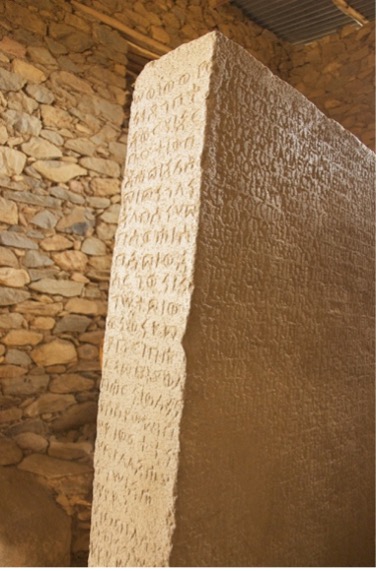
The Ezana Stone still stands in Aksum, Ethiopia. It is the trilingual inscription (Ge’ez, Sabaean, and Greek) that traces Ezana’s shift from pagan to Christian language. Photo by A. Davey, CC BY 2.0, via Wikimedia Commons.
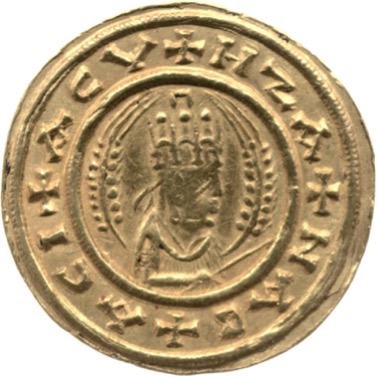
A gold coin bearing King Ezana’s own image, Kingdom of Aksum, c. 340–400. © The Trustees of the British Museum, CC BY-NC-SA 4.0. View object record.
In 356, the Roman emperor Constantius II, under Arian influence, writes to Ezana and his co-ruling brother Sayzana, asking them to replace Frumentius with an Arian bishop.[5] There’s no record they complied with the request. It was the first of many such refusals. Across the centuries, the African church guards what it has received against every power that leans on it to bend. The pressure is heresy, and Rome is the one wavering on the divinity of Christ while these kings hold Nicene ground. In the sixth century, the pressure was persecution. Negus Kaleb crosses the Red Sea into Himyar (South Arabia) to stop a Jewish king from slaughtering the Christian community there, and the Ethiopian Orthodox Church remembers him as a saint for it.[6] In the seventeenth century, the pressure is again from Rome, this time Catholic. Walatta Petros resists a Jesuit campaign to pull Ethiopia under the pope, surviving exile and imprisonment to keep the Ethiopian church Ethiopian.[7]
Over a thousand years before the transatlantic slave trade, Africa already had a Christian king and a mint striking Christian coins. The line of African Christianity that grew out of that reign never needed Europe’s validation. Frumentius and Aedesius did not arrive with power. They arrived in chains and stayed faithful, and God turned their captivity into an empire’s conversion. The hands that finished the job, Athanasius in Alexandria, were African hands too.
Whatever chains you’re in right now, whether circumstances that make no sense or a season that looks nothing like victory, remember that the same God who worked through two enslaved teenagers in a foreign court is still in the business of making emperors bend the knee.
[1] Rufinus of Aquileia, Historia Ecclesiastica, bk. 10, ch. 9, in The Church History of Rufinus of Aquileia, Books 10 and 11, trans. Philip R. Amidon (New York: Oxford University Press, 1997).
[2] Stuart Munro-Hay, Aksum: An African Civilisation of Late Antiquity (Edinburgh: Edinburgh University Press, 1991), 197–200.
[3] Ibid., 200–202; see also the Ezana Stone inscriptions, documented by the British Museum.
[4] Munro-Hay, Aksum, 180–86.
[5] Athanasius, Apologia ad Constantium, ch. 31, in Nicene and Post-Nicene Fathers, 2nd ser., vol. 4.
[6] G. W. B. Huntingford, The Periplus of the Erythraean Sea (London: Hakluyt Society, 1980), introductory notes on Aksumite kings.
[7] Wendy Laura Belcher and Michael Kleiner, trans., The Life and Struggles of Our Mother Walatta Petros (Princeton: Princeton University Press, 2015).


Alexander Wade leads Worthy Redeemer Church in Huntsville, Alabama, as Lead Teaching Pastor, a Reformed Baptist congregation he planted with Pastor Brian Metz in September 2021. Before ministry, he studied marketing at Northwestern College in St. Paul. He left a corporate career in 2016 for pastoral ministry, training at Summit Crossing Community Church in Madison, Alabama, and earned a Master of Theological Studies in Historical Theology at Reformed Baptist Seminary. He is now weighing the possibility of a PhD.
Wade’s research centers on early African Christianity, particularly the Aksumite Empire, and drives Black History Is Church History, the annual conference he hosts. He co-founded Marrow Ministries, where he hosts The Marrow Show. He and his wife Alyssa have four children: Harrison, Samson, Penelope, and Canaan.